Most people looking for a Talo alternative fall into one of two groups. Some want a different general backend, and for them LootLocker or Nakama is the comparison to read. Others like Talo but need something it doesn't do: take payments, run a store and a coin wallet, or sell a season pass. That's where PowerUp comes in. Talo is an open-source backend for Godot and Unity, with saves, leaderboards and live config. PowerUp is a monetization engine for Godot. This page sets out what each does well, as of October 2026, with links to Talo's own pricing and docs.
At a glance
| Talo | PowerUp | |
|---|---|---|
| What it is | A general game backend: players, saves, leaderboards, stats, live config, events | A monetization engine: store, wallet, passes, quests, ads, checkout and checks before publish |
| Open source | Yes, MIT, and self-hostable | No. Hosted, in early access |
| Engines | Godot plugin, Unity package, REST API | Godot 4 SDK, REST API for any engine |
| Sign-in | Its own accounts, plus Steamworks, Google Play Games and Game Center | Its own player tokens, plus transfer and recovery codes. No platform sign-in |
| Leaderboards, saves, stats | Yes, with Steamworks sync for leaderboards and stats | Club tournaments and match records only. No cloud save |
| Live config | Any key and value, pushed to the game | Prices, offers, passes, quests and events, drafted, checked and published |
| Purchases and currency | Not listed | App Store, Google Play and Stripe, into one coin wallet |
| Price | Free to 10k players; $24.99 or $79.99 a month above that | See pricing |
Where Talo is stronger
- Open source, for real. Talo's backend and dashboard are MIT-licensed, with public Docker images and self-hosting examples that run it with MySQL, Redis and ClickHouse in Docker Compose. You can run it on your own servers for nothing but the hosting bill. PowerUp can't be self-hosted.
- Backend breadth. Players and their properties, leaderboards, game saves that work online and offline, global and per-player stats, event tracking, player groups, realtime channels, presence, friends and feedback, plus CSV exports of your data. PowerUp has none of the general ones: no leaderboards API, no cloud save and no general event tracking.
- Platform sign-in. Talo's backend lists Steamworks sign-in and ownership checks, and Google Play Games and Game Center sign-in, and it can sync leaderboards and stats with Steamworks. PowerUp has no platform sign-in.
- Live config for any value. Talo's live config
holds whatever keys you like. You fetch it with
Talo.game_config.get_live_config()and read values as strings withTalo.live_config.get_prop(), it keeps an offline copy, and it tells the game when a value changes. PowerUp only serves its own monetization and LiveOps setup. - Price. Every feature on every plan, and free up to 10,000 players.
- Easy to try. The Godot plugin installs from the Godot Asset Store or itch.io today, and its latest release is 1.2.0, from October 2026. PowerUp is in early access.
Where PowerUp fits
Talo doesn't list purchases, a store or a virtual currency among its features. That whole layer is what PowerUp does:
- A store on every platform. Items, bundles, passes and subscriptions, set up once and sold on web, iOS, Android and desktop. Items only show up in builds that can use them.
- Real checkout. Stripe on web and desktop, the App Store and Google Play on phones, with each receipt checked on our servers and nothing granted twice. See in-app purchases for Godot.
- A coin wallet you can trust. Every coin a player earns, buys or spends is written down, and a refund takes back what the purchase gave. The console flags bundles that leave players with coins they can't spend. See virtual currency.
- Things to sell and earn. Season passes with free and premium tracks, daily and weekly quests counted from real matches, events, a news inbox, clubs with a weekly tournament, and rewarded ads, with AdMob rewards verified on the server.
- Checks before players see a change. 48 automated checks run when you publish, covering prices, offers, ads, passes, game versions and younger players. If one fails, nothing ships.
Live config and published config
Both let you change a shipped game without a new build, but they're built for different things.
Talo's live config is general. Change a value in the dashboard and the game picks it up, which suits enemy speed, a feature switch or a message of the day.
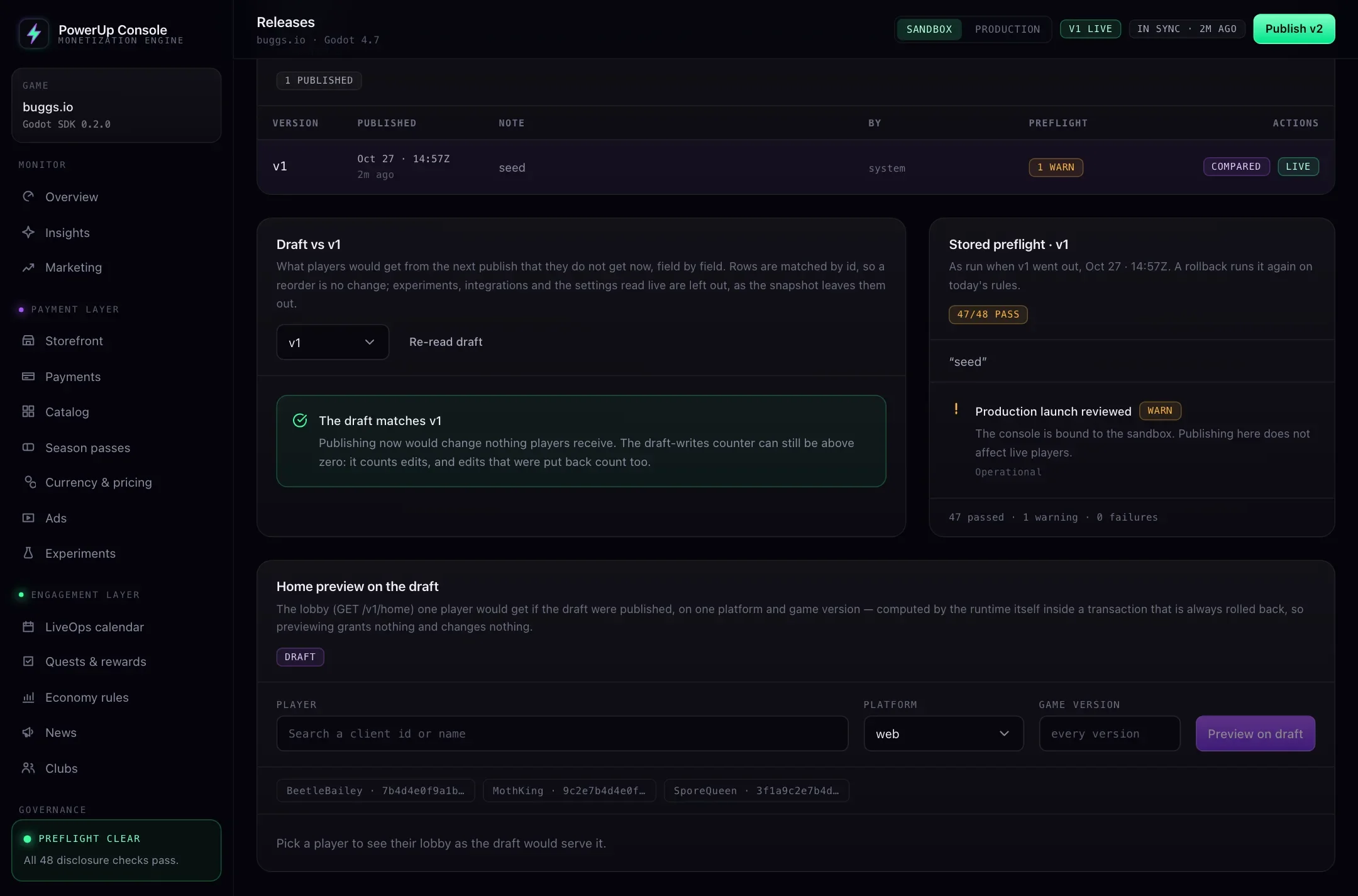
PowerUp's config is the monetization and LiveOps setup itself: prices, offers, coin amounts, passes, quests and events. Edits wait in a draft until you publish, publishing runs the checks, and each release gets a version number, a list of what changed and a rollback. That matters more for prices than for enemy speed, because a wrong price costs players money. Neither replaces the other, and PowerUp doesn't run live A/B tests yet. Remote config for Godot goes into the details.
Pricing
As of October 2026, Talo's hosted plans are Indie (free, up to 10,000 players), Team ($24.99 a month or $224.99 a year, up to 100,000), Studio ($79.99 a month or $719.99 a year, up to a million) and Enterprise (custom). Every plan includes every feature. PowerUp's plans are on the pricing page, and Apple, Google and Stripe take their usual fees on each sale either way.
Using both
Talo and PowerUp fit together without stepping on each other:
- Talo for player accounts and Steam sign-in, saves, leaderboards, stats, analytics events and general live config.
- PowerUp for the store, the coin wallet, checkout, passes, quests and rewarded ads.
PowerUp knows each player by a stable id your game chooses and gives that player a token. Nothing links the two services for you, so keep the PowerUp id and token in the same save as the player's Talo identity.
Which should you pick?
- Pick Talo if you need leaderboards, saves, stats or live config, want open source or self-hosting, or need Steam sign-in.
- Pick PowerUp if your Godot game earns from a store, coins, passes and ads on web and mobile, and you want each change checked before it ships.
- Use both if you need Talo's backend features and a store players pay in.
For LootLocker, Nakama and the rest, see the Godot backends comparison.